
A member of The Ivy Company
» Editor's Note
» Introduction
» Sovereign Credit Analysis: Refinance Assumed?
» Access to Capital and the Asian Crisis
» Falling Asset Returns under GATT
» The Danger of GATT under preferential access to capital
» A Quantitative Analysis for Corporations
» Principal Repayment Burden of Commercial Banking (Level Payment Amortizing) Loans
» US Industrial Free operating Cashflows: A Benchmark for International Corporations
» Summary of Companies Defaulting by Ratings
» Conclusion
» So Whats the Principal Refinance Assumption?
Top
EDITOR's NOTE:
This is an article derived from a ground-breaking piece of financial research prepared by Wharton Partners, a financial research and consultancy firm headquartered in Islamabad. The title of the thesis is :"When the cost of debt is no longer the interest rate. A Breakdown of the principal refinance assumption...". The focus of the paper is a very serious problem emerging in the World's globalizing economy.
Wharton partners argues that underlying a number of fundamental economic theories and models is an assumption that principal repayments of debt can be refinanced with new debt or rolled over. This assumption is breaking down — witness the Asia crisis- the result of which is serious problems in a number of countries in the form of unnecessary corporate failures and stunted economic growth.
Wharton Partners feels the situation is going to get worse. This oversight of assuming refinancing and roll over of debt results in faulty decision making on part of economists, bankers, analysts and policy makers.
In the weeks to come, PAGE will feature a series of articles by Wharton Partners - written by its Managing Partner, Osman Niazi, that deal with different variations of the "principal refinance assumption" and its implications for different components of the World Economy.
We applaud this highly original piece of research, and are quite confident that in the time to come this seminal contribution from Wharton Partners will come to be seen as an integral part of our understanding of global capital markets.
- Suhail Abbas, Managing Editor, PAGE
Introduction
Wharton Partners feels that they can show that there is a serious problem in the current approach of the World trying to open up and liberalize economies. The potentially fatal flaw is in the fact that different borrowers in the world have different ability to access capital that they need. In order to appreciate our claim that GATT is going to turn out to be disastrous for the world economy we first need to explain some issues in credit analysis
for countries. This will lead to our claim.Sovereign Credit Analysis: Refinance Assumed?
Credit analysis of corporations is done differently from analysis of sovereign (countries). The essential's of credit analysis of sovereigns includes looking at its debt levels and repayment in relation with export earnings, trade deficits, GDP, GDP growth etc. In effect the ratings agencies try to evaluate credit for debt of sovereigns based on their assessment of such macro economic factors.
Here is something to note. Credit analysis of sovereigns done by S&P and Moodys obviously assumes refinancing of debt with new debt. Looking at a country running a current account deficit means either its selling assets inside it (like property to foreigners) or its raising new loans. Under this scenario we see what happens if new debt to the country is stopped or its unable to roll over its present debt. The answer would be a default. Pakistan and the United States of America are some of the countries with a substantial amount of National Debt and a large current account deficit. Until recently the US also had a substantial budget deficit for several years. If you assume no refinancing of debt then US and Pakistan along with other countries running large current account deficits should be rated as Default credit. However we see that US Treasury debt is regarded as among the top credit in the world markets. Why is this? It is because the ratings agencies realize that the US can easily raise new debt at low interest rates. Everyone wants to invest in the US.
Access to Capital and the Asian Crisis
This is the problem. World capital moves about based on perceptions. Our argument is that if you deny refinancing of debt to a borrower, you break this refinance assumption. Denying refinancing of debt for rolling over debt is an absolutely unfair standard. In fact very few countries have current account surpluses to such a large extent that they could pay back all their short term debt in a relatively short period. In the case of the current Asian crisis, we feel there was a two step process. Firstly, Thailand triggered a crisis, which changed perceptions about Asia. This change in perception resulted investors not wanting to keep their money in Asia. This resulted in lenders not wanting to roll over short term debt to Korea and Korean companies. We believe this was extremely unfair standard. Under this same limited refinance scenario, you would have had major problems in any of the Western countries. A similar reluctance to finance the US treasury debt would result in a similar crisis for the US. However, despite having fundamental regarding trade and budget deficits condemned in countries in the developing countries, the US never had any problem refinancing debt.
This change in perception about Asia sent a signal to the credit rating agencies who felt that Koreans would have trouble in refinancing their debt. They down graded Korean debt. This further destroyed investor sentiment, this implied a future pull back of further capital and a further break down of roll over and new debt financing. Thus a vicious cycle was created. In our opinion, in the new world economic order, perceptions are enough to create Asia type crises. The logic is pretty simple. If you can't roll over debt you are in trouble. If investors just perceive trouble you can't refinance your debt. A catch 22 situation. This is exactly what happened in the later part of the Asian crisis. The IMF and the US Treasury Secretary Robert Rubin clearly understood this liquidity problem created as a result of a loss of investor confidence. However, what this crisis implies is whoever has privileged access to capital will by default do better than those who cannot refinance their debt. Similarly, perceptions again determine short term exchange rates. Thus you have perceptions determining the economic futures of nations. What makes this situation so dangerous is the globalization of the world economy as we shall explain later.
At a corporate credit analysis level assumption of credit refinance is not so direct. However, a few analysis assume partial refinance of debt principal repayment. Corporate credit analysis includes interest coverage ratios, which see how many times interest can be paid. More interesting are ratios to see if the entire debt payments can be made from cashflow. However, here again credit analysts look at further leveraging abilities of the corporate to see if they can raise more debt to meet shortages in principal repayments.
Falling Asset Returns under GATT
However, the more serious problem in credit analysis in Asia is an oversight. We feel that the true impact of globalization and the relevant trade liberalization under WTO and GATT is not properly evaluated. For the past several years we are progressively going towards one global economy and liberal trade. However, a major implication of this process is a return normalization process throughout the world. This means that economic rents (or abnormally high profits) are disappearing in these liberalizing economies. This is the result of lower protection and higher competition. As a result asset return are falling down in the Asian countries and will fall further as these economies are further liberalized.
The Danger of GATT under preferential access to capital
However, we believe there is a very dangerous oversight in this process. Namely, as returns fall, the ability of corporation in these liberalizing economies, to raise new debt or equity becomes absolutely essential. This is necessary to finance debt principal payments, capex and economic down turns. In this scenario, the Pakistani corporation must be able to raise debt on the same level as a US corporation or else it will not be able to compete. The US corporation can raise 30 year debt, even 100 year debt. The Pakistani corporate cannot even raise 10 year debt. We feel this difference, would not be very dangerous if the company could make debt principal repayment with new debt. However, this is not true. This factor becomes absolutely devastating as the economy is further liberalized. We have seen this effect over the past several years in Pakistan, where we have not managed the economic liberalization process effectively.
On the contrary US corporation such as the US automotive industry became uncompetitive in the US during the 1980's. Similarly other US industry was also in problems. However, with superior access to capital these US corporations were able to run losses for substantial amounts of time. This is an enormous competitive advantage, which we feel dominates all other factors. Our analysis of business returns has convinced us that superior access to capital is by far the most important factor in attaining competitive advantages for highly leveraged companies.
What has to be realized is that GATT may well turn out to be absolutely dangerous to the world economy if an appropriate system is not developed for making sure that fair access to capital is available in all countries. The fact that a corporation which cannot access capital underperforms if it does not outright fail. Thus perceptions and credit analysis as done right now, result in self-fulfilling prophecies. In the globalizing economy with capital running after perceptions will result in the tail wagging the dog. Credit availability will determine credit worthiness. A new system must be developed before the developing counties go into very serious economic problems. This could result in massive industrial defaults and banking failures as has already happened in the case of Pakistan. Economic liberalization must be done properly. Following WTO blindly could result in the whole world paying for a long time.
A Quantitative Analysis for Corporations
To this point we have presented results in a qualitative manner. These results primarily for the sovereigns. To appreciate this problem for corporates in more detail it is important to look at it with a few numbers. This would become even more interesting as implications of corporates not rolling over their debt or being able to refinance debt principal repayments is even more significant.
Principal Repayment Burden of Commercial Banking (Level Payment Amortizing) Loans
Debt Financing in the Asian countries is done primarily using commercial banking loans. These could be short term loans for working capital financing or term finance loans. Term finance loans have been used for industrial project financing in these countries. These loans are usually structured as level payment loans i.e. each repayment is of equal total value.
Lets look at the amount of principal that need to be repaid for loans of different maturities during the initial period of the loan. The debt principal repayment burden as a percentage of the debt itself is shown in the following graph. This is based on an interest rate of 10%. The reason for using 10% is discussed in detail in our research paper. Suffice it to say that the 10% rate implies principal repayments consistent with a conservative estimate for the burden on the company.
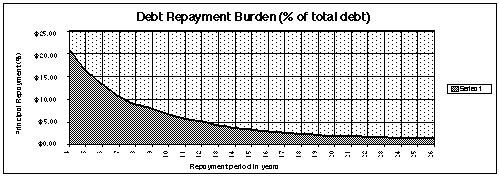 We see that the graph decays exponentially. Also the excess burden for
servicing the principal repayments alone is very severe for the short repayment
schedules. The burden for a 5 year repayment is 16.38%. This drops to 6.27%
for a 10 year repayment schedule. This is a difference of over 10%!! The
difference between a 15 and 20 year repayment is less than 3/4ths of a
percent.
We see that the graph decays exponentially. Also the excess burden for
servicing the principal repayments alone is very severe for the short repayment
schedules. The burden for a 5 year repayment is 16.38%. This drops to 6.27%
for a 10 year repayment schedule. This is a difference of over 10%!! The
difference between a 15 and 20 year repayment is less than 3/4ths of a
percent.
This graph gives us an idea of the principal repayment burden for a corporation using a commercial banking loan for project financing. Now if there is enough credit in the market and the company is considered to be able to lever up further, then even if it finances debt with a 4 year loan, it can effectively roll over its debt with new debt.
The danger is if credit dries up in a country and the company cannot raise new debt. (This scenario has been true in Pakistan and Bangladesh in the past and has partially come true in the current Asian crisis). Under this scenario if this repayment burden is too much, companies will start faling. To see if this burden is excessive, we need to survey what kind of profits are common in the world. We will come to this point later. Just some comments about the graph first. If debt roll over or refinancing is limited then we have to make sure that the repayment of debt is completely covered in profits generated by the business. We feel that if banks are going to use level pay loans for project financing, it is essential that they project finance at the flatter part of the graph where the excess burden of principal repayment on the borrower is more reasonable (past ten to fifteen years). However, in reality lenders to emerging markets consider long tenor loans as risky in these countries. As a result they finance projects on the initial part of the graph. This view results in extreme danger in a liberalizing economy. The default probabilities go up significantly under credit crunch environments. Its ironic that by considering long term debt risky and lending short term, the banks actually increase the chances of a default under a credit crunch environment such as the one prevailing in the current Asian crisis.
This ties in directly with the dangers of GATT. A US corporation with 30 year debt structured as a bond has perhaps no amortization of debt in the initial 10 years. However, an emerging market company with a 5 year repayment schedule has to repay 16% of its debt structured as a commercial banking loan. This produces an enormous difference and, what we feel is, an unfair burden on the Asian company. This is especially bad when under GATT all avenues for generating economic rents (Abnormally high profits due to a protected economy) are disappearing. Economic rents in fact are a crucial reason how emerging markets companies can survive in a world where capital is distributed based on perceptions. Here we must reiterate that this repayment burden is a dominant factor. If the US company can roll over most of its debt but the Korean cannot, this is not reasonable. Similarly, as we mentioned earlier, the US industry with superior access to capital can run losses for significant periods of time. In Pakistan during the mid 1990's, new prudential regulations, explicitly made sure that a majority of small and medium Pakistani companies not meeting the principal repayment burden would fail.
It is our analysis that given the increasing globalization of the world economy under GATT, it will become increasingly difficult for corporates to repay debt principal repayments associated with medium term commercial banking loans. Under this scenario corporations must have fair ability to raise capital.
US Industrial Free operating Cashflows: A Benchmark for International Corporations.
Now that we have some idea of the principal repayment burden of commercial banking type debt, we now look at free operating cashflows of US corporations and see how they would fare using commercial banking debt and limited refinancing of debt principal repayments. The following data is from the Handbook of Fixed Income Securities, Frank Fabozzi & T. Dessas Fabozzi.
Summary of Companies Defaulting by Ratings
Using the free operating cashflow numbers and looking at the principal repayments burden (from the graph above). We see that the median free operating cashflows of A rated companies can bear the burden of a 6-7 year debt. BBB rated median companies cannot even meet a 12 year repayment. Non investment grade companies need a cash inflow to avoid default. The point being that if the refinance assumption breaks down (i.e. corporation cannot roll over debt or refinance), a large and unfair burden is placed on a number of industrial companies in that country. If companies are making large economic rents they may survive. However under liberalizing economies and shrinking profitability, these companies could very likely face undue and potentially defaulting burdens. This data is median data. Below median higher rated companies could be in trouble (Above median BBB may survive too). In fact since the free operating cashflows for the median A rated Company was 11.1 as compared to a principal repayment requirement, means that perhaps almost half A rated companies would default if the credit restriction were in place.
We must point out that we feel free operating cashflows are the proper flows to compare with the principal repayment burden. The reason being they incorporate actual capex, disregard depreciation and is the net cash available to retire new net debt. We feel in a competitive globalizing economy corporations of various countries must have the ability to do necessary capex to maintain competitiveness and as such using US capex numbers provides a useful benchmark.
Conclusion
Basically what these analysis show is that asset returns are not very high compared to the terms of financing. Should anyone be financed using short term debt and is denied refinancing of debt principal repayments, they stand in a very dangerous position if suddenly they cannot refinance debt and worse if their asset returns shrink. The unexpected danger of the WTO could be this factor as WTO will result in lower returns as a result of lower protection, yet commercial banking type debt is being used from debt financing. This has illustrated the crucial importance of fully operational investment banks and capital markets to provide sufficiently long term capital.
So Whats the Principal Refinance Assumption?
Wharton Partners has studied this problem arising from this structuring problem for almost two years now. We wanted to understand why this problem was not identified earlier. Our analysis revealed a very interesting result which is the core idea of our research. What we realized was that refinance or roll over of debt was implicitly a standard assumption behind most macroeconomic models and a lot of financial theory. We feel this is a crucial flaw which has led to many incorrect decisions regarding a number of economies. Pakistan and Bangladesh have felt the effects of this problem stretched over some time. The rest of Asia has suddenly been thrust into it. Even preceding the Asia crisis, we expected trouble like this to spread as we felt that with more economic trade liberalization under GATT, this problem would be exposed. We have had the opportunity to develop several angles for this problem over the past year.
Osman Niazi Managing Partner, Wharton Partners Inc.